Open Instagram. Look at any ten independent restaurants in your city. Cover the names with your thumb.
Could you tell which one is which?
For most, the answer is no. Same plates lit the same way. Same caption length. Same six adjectives in rotation: fresh, authentic, passionate, crafted, seasonal, delicious. Different restaurants. Same voice.
This is not a creative problem. It is a strategic one. And it is costing the average independent restaurant something specific and measurable: a meaningful share of the algorithmic reach platforms hand to accounts they recognise, and a meaningful share of the revenue lift that consistent branding has been shown to produce across thousands of companies.
This article is a complete walkthrough of what restaurant brand voice actually is, why the platforms and the customers reward it, and the seven decisions that turn a generic feed into one a regular would recognise from across the room.
What restaurant brand voice actually means
Restaurant brand voice is the consistent personality, tone, and word choices a restaurant uses across every public touchpoint: its captions, its review responses, its Google profile, its menu copy, its emails. It is the way the restaurant sounds when the owner is not in the room. A clear brand voice makes a restaurant recognisable across every platform; the absence of one makes the restaurant indistinguishable from its competitors.
That definition matters because the practical version of brand voice is often confused with adjacent things. Brand voice is not a logo. It is not a colour palette. It is not the words on your homepage.
Brand voice is how your restaurant sounds when you are not in the room. The way an employee writes a caption when you are on holiday. The tone of the reply your manager sends to a one-star review at midnight. The personality that comes through when a Google profile sentence is the only thing a hungry stranger sees before they decide where to spend €70.
The principle is simple: everything your restaurant publishes should feel like it came from the same person. Not a corporate "voice." A person. The same person, every time.
This is harder than it sounds. Most independent restaurants have at least three people writing content over the course of a month: owner, manager, sometimes an intern, occasionally an agency. Each one writes from their own defaults. The Tuesday post is warm and casual because the owner wrote it. The Thursday post is precise and reserved because the chef wrote it. The Saturday post is high-energy and playful because an intern wrote it. From the customer's side, this looks like three different restaurants posting under the same name.
The reason this matters has nothing to do with aesthetics. It has to do with three measurable forces, each of them stacking on top of the others.
Why brand voice drives revenue (the proof)
The case for brand voice has been studied across thousands of companies. Three findings carry most of the weight.
Finding 1: Consistency drives 23–33% revenue lift
Lucidpress's State of Brand Consistency Report, now updated across multiple years and 1,800+ brands, found that companies maintaining a consistent brand across touchpoints achieve revenue increases between 23% and 33%. The 2019 update showed 33%. The 2024 cross-industry tracking confirmed the effect at 23.4% on average. The strongest gains appeared in service categories where trust matters most, and restaurants are a service category.
Finding 2: Posts with a clear personality see meaningfully higher engagement and follower growth
Industry analysis of brand voice impact on social media suggests that posts with a distinct, consistent personality see roughly 23% higher engagement and 60% faster follower growth than posts that read as generic or templated. The mechanism: users decide whether to engage in under three seconds, and personality is the single fastest signal that the account is worth their time. Bland posts get scrolled past, even when the underlying photo is excellent.
Finding 3: Inconsistency actively repels customers
PwC's research found that 32% of customers will walk away from a brand they love after one bad experience. For restaurants, "bad experience" includes the dissonance of arriving at a quiet Tuesday lunch after seeing an Instagram caption that promised raucous energy. The promise and the room have to match. When they don't, the customer feels misled, and they don't come back.
The honest version: a restaurant that sounds like itself across every touchpoint earns more revenue, retains more guests, and converts new visitors faster. The numbers above are not hype. They are the average, across thousands of companies, of what consistency is worth.
Why platforms algorithmically reward brand voice
This is the part most restaurants don't know about, and it matters more than the revenue numbers.
The major platforms (Instagram, TikTok, Google, Meta) are built around algorithmic systems that rank content by how confidently they can predict it will perform. Confidence comes from history. The platform looks at your account and asks: do I know what to expect from this account?
If the answer is yes (same voice, same visual register, same kind of value delivered every time) the platform feels safe pushing your content into Explore, Reels suggestions, and the discovery surfaces where new audiences live. If the answer is no (random tone, random style, random posting cadence) the platform's confidence drops, and your content gets shown almost exclusively to people who already follow you. Reach collapses.
Platforms reward predictability of value. Predictability of value is exactly what brand voice produces.
This is why two restaurants with the same follower count can have ten times the reach difference. Hootsuite's 2026 Instagram algorithm research explicitly names content quality, originality, and consistency as three of the strongest ranking signals across Feed, Reels, and Explore. Sprout Social's 2026 update confirms the same finding from a different methodology: content with predictable performance trains the algorithm to surface more of it, which compounds into reach over time.
Google's local search ranking works on the same logic. A Google Business profile that posts updates in a consistent voice, with consistent photo styling, gets surfaced more confidently in the Map Pack than one that looks abandoned half the time and frantically corporate the other half.
The takeaway: brand voice is not a soft asset. It is a hard input to your distribution. Restaurants without one are paying a tax in reach they can't see on any invoice.
The four-dimension framework (academic foundation)
Up to this point we have argued why brand voice matters. Now we need a precise way to describe what a brand voice actually is. The most rigorous answer comes from research conducted by the Nielsen Norman Group, the most-cited UX research organisation in the world.
In a study analysing tone of voice across hundreds of websites, NN/G's researchers reduced the entire question to four measurable dimensions:
- Funny vs. serious: does the writing attempt humour, or treat the subject straight?
- Formal vs. casual: is the language professional and polished, or relaxed and conversational?
- Respectful vs. irreverent: does the writing treat its subject (and category) with reverence, or with playful subversion?
- Enthusiastic vs. matter-of-fact: does the writing convey excitement, or deliver information without affect?
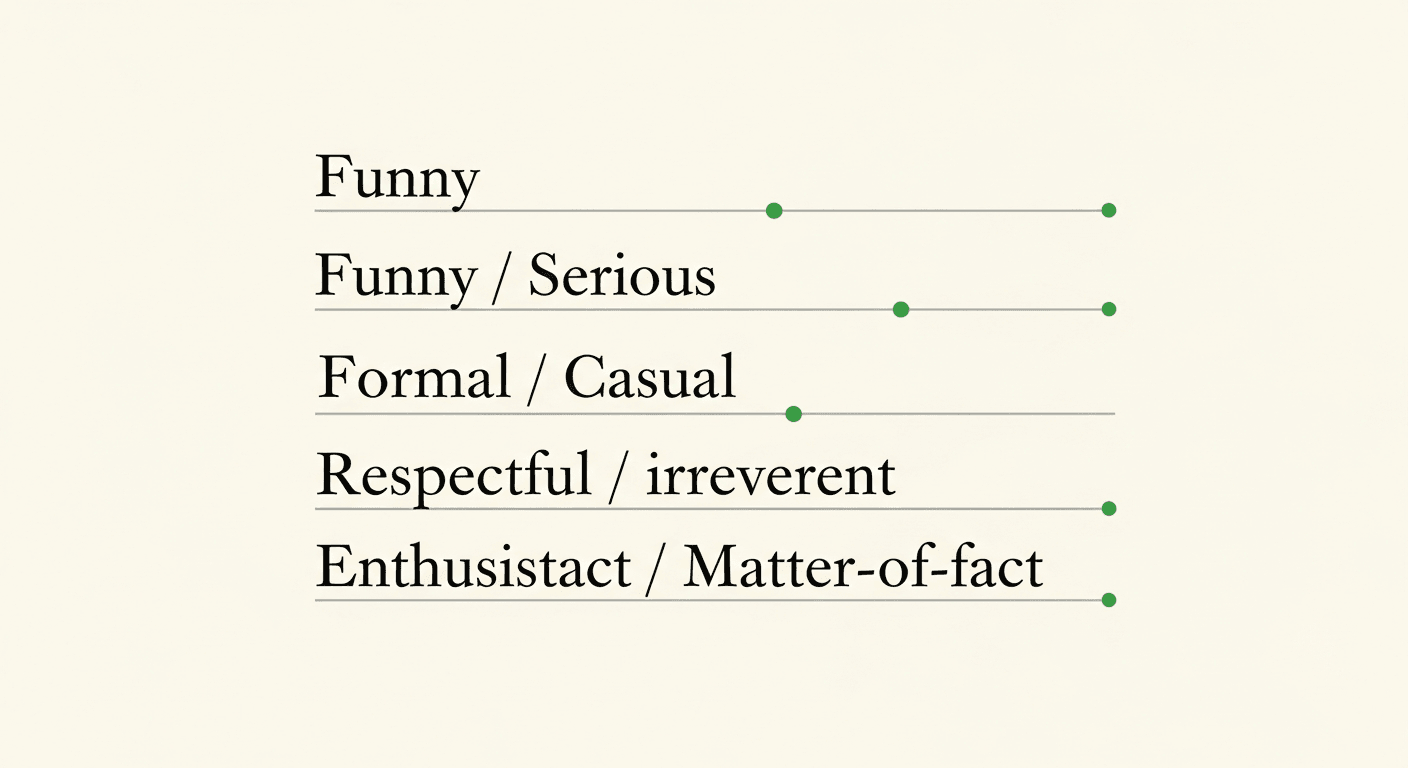
For a restaurant, the framework looks like this in practice:
- A third-generation Neapolitan trattoria in Den Bosch is probably serious, casual, respectful, matter-of-fact. The kitchen has rules. The grandmother's recipes have weight. The voice doesn't crack jokes about the carbonara.
- A late-night bao spot in the Jordaan is probably funny, casual, irreverent, enthusiastic. The voice is different from the trattoria's because the restaurant is a different kind of place. The same caption template would feel wrong on either feed.
Most restaurants never make these choices explicitly. So the voice drifts to the middle of every dimension, which is exactly where personality dies. NN/G's research found that bland tones perform worse than even imperfectly-executed strong tones, because no signal is worse than a slightly-wrong signal. The middle of every dimension is where personality dies. Pick a side.
Why most restaurants get this wrong
Three reasons, each common, each fixable.
The seven-step framework to build a real brand voice
Below is the framework a serious branding agency would walk a restaurant through. Working through it honestly takes about ninety minutes. The output is a document any staff member can apply, and one the algorithms can learn to recognise.
How a real branding agency builds this
The seven-step framework above is what a serious branding agency would walk you through. The reason it works is that the steps are actually seven different kinds of thinking, and combining them collapses the dialogue.
This is where most automated tools fail. A generic automated brand generator takes a one-page questionnaire and produces a brand voice in thirty seconds. Half of those outputs read as generic, describing any restaurant of the same type rather than yours specifically, because the system did all seven kinds of thinking in one pass and averaged the result.
What works instead: the same seven steps, but as a sequence of distinct passes. Each pass with its own specialist, its own quality bar, its own constraint. A research analyst reads the discovery material before any framework is applied. A foundation writer documents what's actually there before any strategic claim. A positioning workshop forces a real position through adversarial dialogue (a drafter, a critic, a refiner). A voice and persona specialist turns the position into rules a junior writer can apply. A platform strategist writes per-platform playbooks. A coherence critic catches contradictions across all the prior work. An assembler turns it all into a document the owner reads in fifteen minutes and recognises.
The point of describing this pipeline is not to sell a process. It is to show what the work actually involves at a serious level. A brand voice is not produced by one person sitting down for an afternoon, and it is not produced by one automated prompt. It is produced by seven different kinds of thinking, each doing one job well, each handing off cleanly to the next. The output reads like one voice because the process is structured to keep one voice across seven different kinds of thinking.
This is the difference between a brand voice document that sounds like every other restaurant and one that sounds like yours. Anyone can produce the first one in five minutes. The second one takes the work of seven specialists, however that work gets done.
Three steps any restaurant can take this week
The seven-step framework above is the full version. A small restaurant doesn't need to wait for the full version to start. Three steps, applied this week, will move most restaurants meaningfully.
The cheapest brand voice work is the work you actually finish. The most expensive is the unfinished document that drifts.
Step 1. Pick a position on each of the four NN/G dimensions in a single afternoon. Not "balanced" on any of them. Pick a side. Test it against the last twenty captions you have posted. Most owners discover their captions are at three different positions on at least one dimension. That is the gap to close first.
Step 2. Write the "words we never use" list. Then write the "words we always use" list. Make sure no staff member writes a caption without consulting both. The "never" list is what will save you from sounding like every other restaurant.
Step 3. Set up a quality gate. Before any caption ships, ask the two-question test: does this sound like us? and would anyone know which restaurant this is from? If the answers are weak, rewrite. The discipline of asking the questions is the consistency.
These three steps, applied for ninety days, will move most restaurants from a feed that could be anyone's to one that is unmistakably theirs. The platforms will notice within the first thirty days. Reach will start to climb. Reviews will start to mention things that were vague before. The restaurant will start to be recognised faster, by more people, in less time.


